Selected platform elements subject to pending U.S. patent applications Member of NVIDIA Inception
Plasma-assisted thermionic conversion

Persistent power for systems that are hard to service

TorrideX is developing a conversion core intended to transform persistent heat sources into continuous electricity for remote, autonomous and mission-critical systems.

The current program is advancing through non-radioactive laboratory validation.

Current stage Early laboratory validation
Current hardware path Non-radioactive planar test stand
Primary gate Repeatable net electrical output
Customer problem

Service logistics can cost more than the electricity

“The electricity may be inexpensive. Reaching the equipment is not.”

Where conventional power becomes expensive

  • Remote battery replacement requires travel, vessels, aircraft or specialist labor.
  • Fuel delivery creates recurring logistics, storage and maintenance burdens.
  • Solar availability can be constrained by darkness, dust, weather, latitude or concealment.
  • Downtime can interrupt monitoring, communications, safety functions or data continuity.

Where TorrideX is intended to fit

TorrideX is not positioned as a substitute for grid electricity, consumer batteries or ordinary backup generators. The intended value is persistent operation where servicing is difficult, dangerous or economically disproportionate.

  • Unattended sensing and telemetry
  • Extreme-environment instrumentation
  • High-value autonomous systems
  • Long-duration monitoring infrastructure
Current stage

One physical risk, one controlled validation program

TorrideX is an early-stage R&D program progressing from concept definition and preliminary modeling toward laboratory proof of the common conversion core.

Already established: system architecture, preliminary thermal and charged-particle models, an initial in-house simulation stack, patent filings and a staged validation plan.

Not yet established: loaded electrical output, positive auxiliary-adjusted net power, validated efficiency, endurance or product qualification.

Development level Approx. TRL 2
Near-term objective Progress toward TRL 3
First heat source Controlled electrical heater
Regulated material Not used in first validation stage
Validation program

Evidence before performance claims

The validation program separates modeling, hardware readiness and measured results. Status labels describe the current evidence level rather than a future product promise.

Milestone Status Acceptance criterion Evidence path
Conversion architecture Established Physics assumptions and energy pathways documented Public technical overview
1D thermal solver Initial version complete Energy balance and analytical regression tests pass Model summary and version-controlled code
Radiation-gap thermal model Implemented Benchmark and regression cases remain reproducible Technical note
Charged-particle benchmark Preliminary Reference conditions can be reproduced and traced COMSOL / in-house benchmark report
Self-consistent plasma model In development Charge, field and particle coupling converge under documented assumptions Pending
Test-stand requirements In development Geometry, instrumentation and measurement protocol are frozen Bench specification
Non-radioactive test stand Planned build phase Vacuum, thermal and electrical subsystems operate together Laboratory records
Loaded electrical output Not measured Repeatable power into a defined resistive load Test report
Auxiliary-adjusted result Primary gate Complete input/output accounting with uncertainty Validation report
Independent review Planned Third-party review of protocol and results Partner report
Persistent-source integration Future phase Only after conversion-core validation and regulatory planning Future program

Primary success criterion

Repeatable electrical output under a defined load, measured against complete system input power, with auxiliary-load subtraction, controlled baseline comparisons, artifact testing and documented uncertainty.

Engineering and simulation infrastructure

Traceable engineering support for physical validation

TorrideX is building a version-controlled engineering simulation stack to plan experiments, verify physical models, quantify uncertainty, and assimilate laboratory data. The platform connects analytical benchmarks, external multiphysics comparisons, internally developed solvers, and future experimental measurements.

Simulations support—but do not replace—experimental validation.

The infrastructure is not a validated digital twin, a replacement for COMSOL, a standalone SaaS product, or evidence of confirmed TorrideX power, efficiency, or full plasma behavior.

01 Analytical Physics
02 Verified Internal Solvers
03 COMSOL Regression Benchmarks
04 Laboratory Measurements
05 Model Calibration
06 Design Optimization
Verified foundations

Benchmarked and reproducible

  • Thermal 1D analytical multilayer model with energy-balance checks
  • Conservative finite-volume thermal solver with analytical-to-numerical verification
  • Xe conduction and diffuse-gray radiative-gap model with nonlinear and limiting-case tests
  • Unit-safe Richardson–Dushman thermionic-emission module
  • Document-based COMSOL Legacy v03 thermal and thermionic regression
  • Analytical and numerical 1D parallel-plate electrostatics
  • Analytical particle trajectory
  • CPU collisionless particle reference
  • NVIDIA Warp GPU particle reference
  • CPU/GPU trajectory cross-check
  • Same-device GPU repeatability
In development

Collisional and coupled particle physics

  • Xe elastic collisions
  • CPU/GPU collision cross-check
  • Energy-dependent Xe cross sections
  • Ionization and excitation
  • Space-charge coupling
  • Experiment-data schema and provenance
  • Three-dimensional thermal FEM
Future

Calibration and optimization

  • Self-consistent charge, field, ionization, and plasma coupling
  • Calibrated uncertainty models tied to laboratory measurements
  • Surrogate models after a sufficient verified case library exists
  • Product-specific design-space exploration
  • Customer-specific engineering configurations

Collisionless particle verification status

Collisionless electron trajectories have been independently implemented on CPU and NVIDIA Warp GPU and cross-verified against an analytical reference on the tested RTX 5090 platform.

This result is limited to the tested collisionless trajectory regime. Xe collisions, collision cross-verification, energy-dependent cross sections, ionization, excitation, and space-charge coupling remain under development.

COMSOL regression ≈0.306% reconstructed current difference
Diagnostic comparison ≈0.020% using COMSOL-reported average surface temperature
Electrostatics benchmark ≈45.45 kV/m across reconstructed 22 mm gap at 1,000 V
Verification basis Analytical, numerical, limiting-case, and provenance checks

What can be shown publicly

  • Analytical versus numerical temperature profiles
  • Convergence and energy-balance evidence
  • Document-based COMSOL current comparison
  • Electrostatic potential and electric-field profiles
  • Collisionless analytical / CPU / GPU trajectory comparison
  • Same-device GPU repeatability evidence
  • Version provenance, source hashes, and result classification

Why this reduces technical risk

TorrideX is not relying on isolated simulation screenshots. Physical assumptions, solver versions, external benchmarks, convergence checks, known limitations, uncertainty, and future laboratory measurements are recorded within one reproducible engineering workflow.

The platform reduces technical risk by connecting model verification, experiment planning, laboratory calibration, and product-specific optimization.

The COMSOL comparison is a document-based regression, not experimental validation. The verified CPU/GPU particle result covers collisionless trajectories on the tested RTX 5090 platform; it does not cover collisional transport, ionization, excitation, space-charge effects, or self-consistent plasma behavior.
Evidence

What the current evidence does—and does not—show

Every public figure, model and image should carry an explicit evidence label. Concept renderings and program memberships are context, not proof of device performance.

Thermal modeling

Calculated / modeled

Initial multilayer thermal calculations, energy-balance tests and radiative-gap implementation.

Not experimental validation

Particle transport

Simulated

Preliminary charged-particle behavior under defined electrostatic and xenon-collision assumptions.

Does not establish net power

Test-stand architecture

Under development

Planar geometry, measurement controls, baselines and artifact-rejection logic are being defined.

Current hardware design

Performance

Not measured

No validated loaded output, net-positive operation, efficiency or endurance result is claimed.

Primary laboratory objective
How the core works

Persistent heat, direct electron collection and optional thermal recovery

The radioisotope is not the mandatory operating mechanism of the first validation system. It is one possible future persistent heat source, physically separated from the conversion environment.

Persistent heat source
Heated emitter
Thermionic emission
Plasma-assisted space-charge mitigation
Direct DC collection
Optional residual-heat recovery
Auxiliary-adjusted usable output

1. Thermionic channel

A heated emitter releases electrons toward a cooler collector. This is the primary direct conversion path under investigation.

2. Plasma assistance

A controlled weakly ionized environment is intended to mitigate electron space-charge limitations. The plasma is not treated as a source of free energy.

3. Thermal recovery

A secondary thermoelectric stage may recover part of the remaining heat and support full-system energy accounting.

Modeled power and efficiency values are design targets only. They have not been experimentally validated and are intentionally excluded from headline specifications.
Product architecture

One conversion core, staged market pathways

TorrideX Core is the common technology under validation. Customer-facing pathways are sequenced behind the same physical gate rather than presented as three finished products.

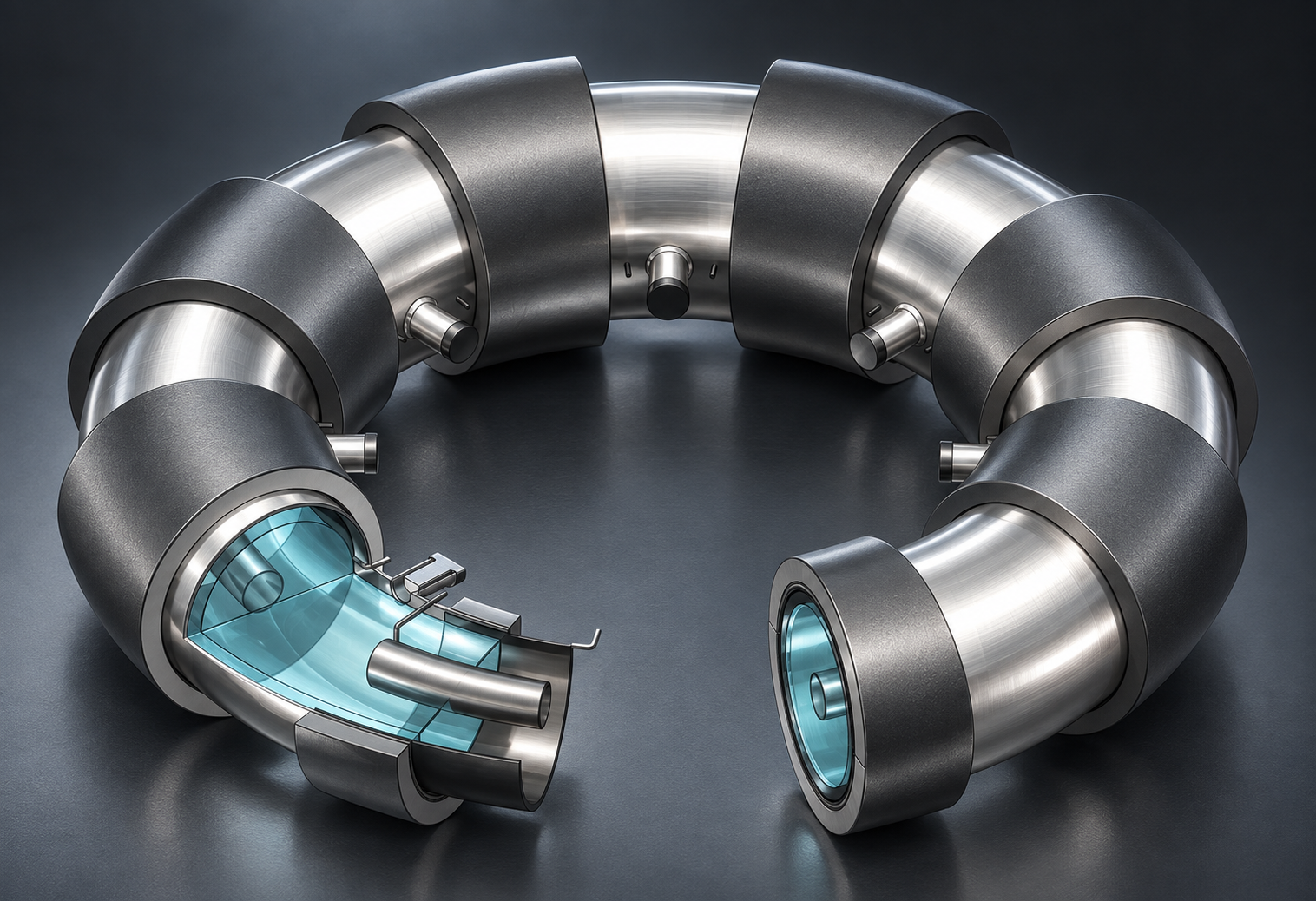
Concept rendering of the TorrideX Sentinel pathway
Initial pathway

TorrideX Sentinel

A persistent-power development pathway for unattended sensors, telemetry nodes and monitoring systems where battery replacement is expensive or hazardous.

Status: Product-development pathway following Core validation.

Concept rendering — not experimentally validated

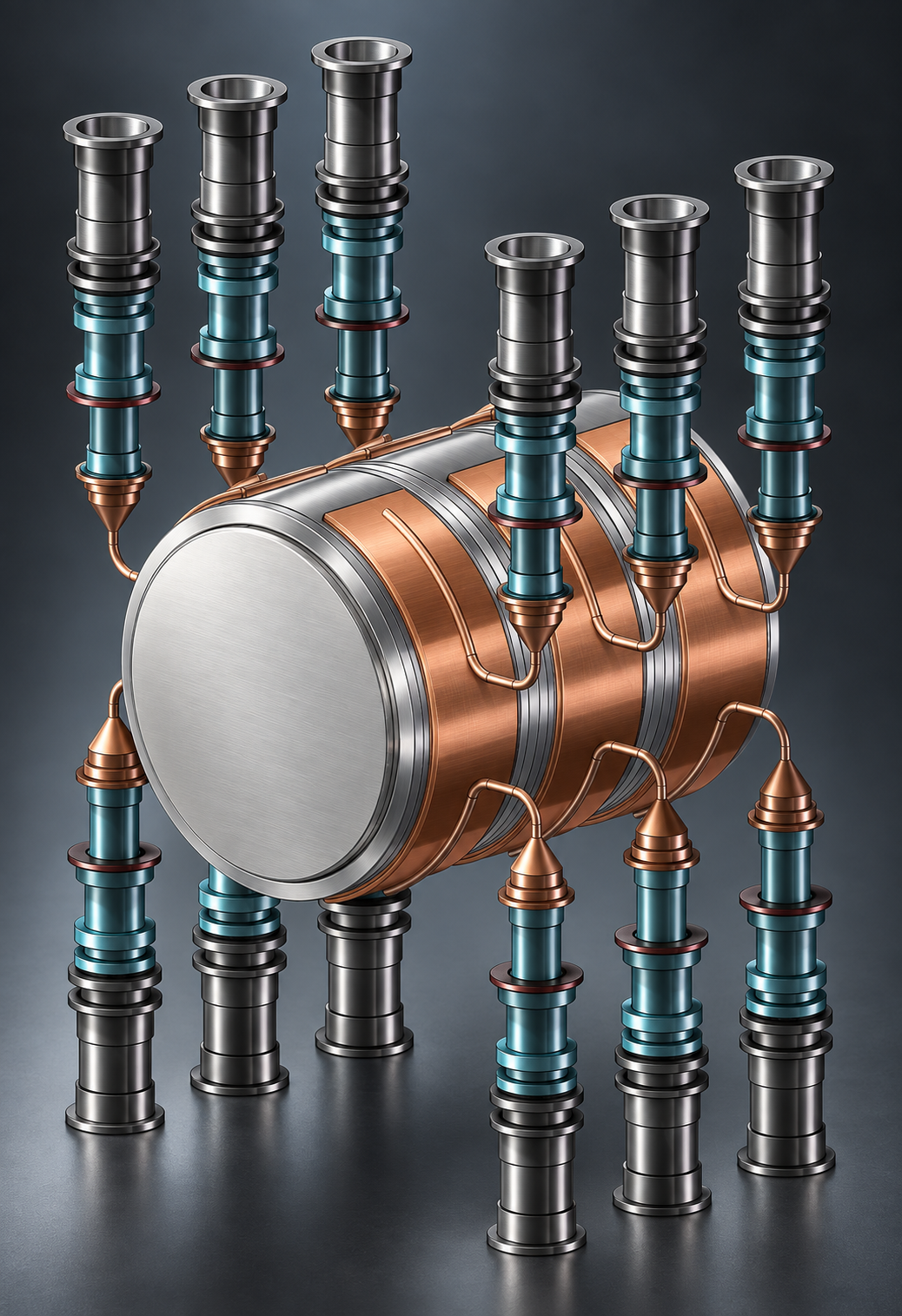
Concept rendering of the TorrideX Mission pathway
Future qualified pathway

TorrideX Mission

A future extreme-environment pathway for aerospace, lunar, planetary, deep-ocean and fixed defense instrumentation.

Status: Future development requiring source, environmental and safety qualification.

Concept rendering — future architecture

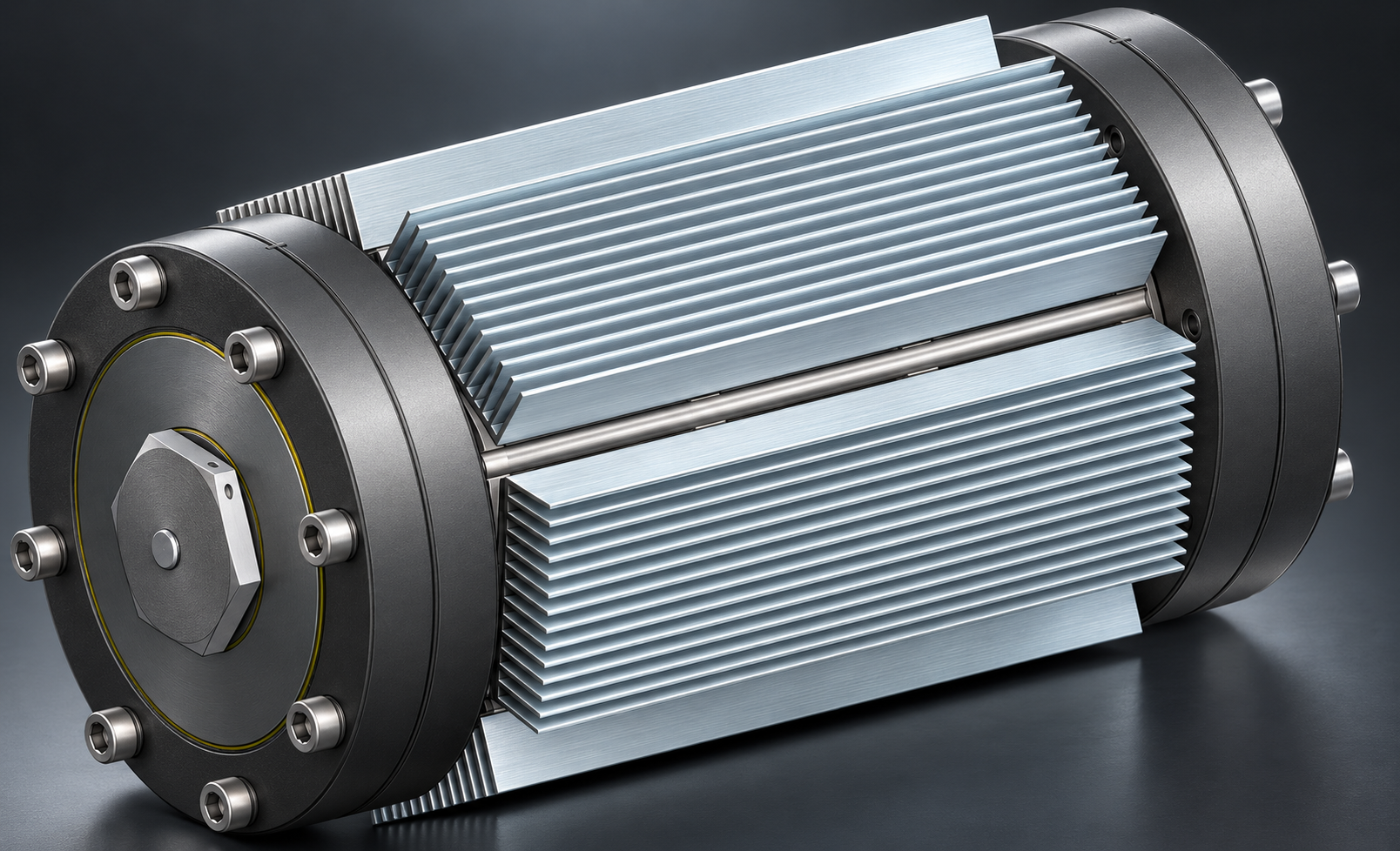
Concept rendering of the TorrideX Recovery pathway
Long-term site-integrated pathway

TorrideX Recovery

A long-term architecture intended to evaluate conversion of a portion of the heat already emitted by stored radioactive materials into useful electricity at licensed nuclear facilities.

Status: Long-term research and site-specific development.

Concept rendering — not a waste-disposal system

Initial applications

Jobs that justify persistent power

Remote infrastructure

  • Pipeline corrosion monitoring
  • Bridge, dam and levee sensing
  • Remote weather and wildfire detection
  • Arctic or offshore telemetry

Scientific and government systems

  • Seismic and under-ice instruments
  • Deep-ocean research nodes
  • Unattended perimeter sensing
  • Emergency radio repeaters

Long-term qualified pathways

  • Lunar surface instruments
  • Planetary weather stations
  • Dry-cask monitoring and telemetry
  • Robotic inspection support
Customer economics

Avoided service cost, not commodity electricity

The first commercial case should be evaluated against total lifecycle cost: replacement visits, access logistics, downtime, lost data, fuel handling and maintenance—not only the price per kilowatt-hour.

Customer value ≈
avoided service visits
+ avoided downtime
+ preserved data / mission continuity
− system acquisition and qualification cost
Team and capability build

Founder-led engineering with defined specialist needs

Nikolai Kulikov — Founder & CTO

Mechanical engineer and deep-tech inventor leading system architecture, mechanical design, prototype planning, simulation integration and technical documentation.

Current capability priorities

The next stage benefits from specialist support in plasma and thermionic physics, vacuum engineering, high-temperature materials, low-current measurement, power electronics and future nuclear regulatory planning.

Corporate, IP and regulatory context

Clear separation between current R&D and future regulated systems

Corporate identity

TorrideX is a project and technology brand being developed by Kulicage Dynamics LLC, a North Carolina limited liability company.

Intellectual property

Selected platform elements are the subject of pending U.S. patent applications. Public materials intentionally omit sensitive implementation detail.

Regulatory sequence

The first validation program does not use radioactive material. Any future persistent-source configuration would require qualified partners, source engineering, safety analysis and applicable licensing.

Contact

Discuss validation, technical review or partnership

Public technical materials can be shared without disclosing implementation details. Confidential materials are available selectively under an appropriate agreement.

Email: nikolai@kdyn.tech

Location: Charlotte, North Carolina, USA